HARDA Background
HORN OF AFRICA REGIONAL DEVELOPMENT ACTION (HARDA) is a non-profit making organization that was registered in 2008 under the name of Elwak Somalia Peace Committee (ESPC) and it has been operating in the cross-border area of Elwak Kenya and Elwak Somalia of Jubbaland Region and under the umbrella of Conflict Early Warning Early Response Unit (CEWERU).
After more than 15 years of working on peace building and conflict management, Livelihood Programmes and Peaceful Election, ESPC has graduated and transformed itself into a fully-fledged NGO and re-branded itself as HORN OF AFRICA REGIONAL DEVELOPMENT ACTION (HARDA) and registered in 2020 with the Kenya National NGO’s Board with registration no: OP.218/051/20-124/11904. HARDA is
also registered with the Federal government of Somalia as well as various states including: Puntland, Jubaland
and South West states of Somalia. HARDA works in cross-border areas of the Horn of Africa particularly in the countries of: Kenya and Somalia.
The main office of the organization is in Mandera (Kenya) with satellite offices in El-wak Kenya and El-wak Somalia, and Garowe (Puntland).
HARDA has bigger scope than its predecessor (ESPC) and strives to formulate a long-term strategy that will enable the cross-border communities to actualize peaceful co-existence and allow sharing of the cross-border natural resources. HARDA seeks to empower pastoralist communities through sustainable community-driven development interventions to promote food security, enhance the living conditions of the communities and provide the basis for the social and economic transformation which will enhance community resilience to climatic and man-made shocks common in the region.
The organization has a clear strategies and operational policies on how to conduct various interventions. We strive to pursue long-term and sustainable development in collaboration with the beneficiary communities, government, development actors and other stakeholders to ensure successful implementation planned interventions.
HARDA Vision
An empowered, progressive and resilient community
Mission Statement:
To improve the well-being of vulnerable ASAL communities through sustainable development
- Respect for human rights – to uphold and respect basic human rights as enshrined in the constitution
- Respect traditional institutions, religious beliefs and cultural practices
- Honesty and integrity, Accountability and Transparency
- Professionalism – Commitment to quality work and Excellence
- Provide equal job opportunities across gender, clan and religious lines
- Commitment to innovation and creativity – promote and support creative and innovative solutions to challenges afflicting humanity
- Environmental protection
- Commitment to sustainability
- Equity and respect for human rights – We hold that all individuals are equal and should be accorded the dignity and worthiness that they deserve.
- Cooperation and partnerships: we work with various stakeholders and actors – community, county and
national governments, development sector actors, faith-based organizations, among others, in our interventions.
- Commitment and service to community – We take service to humanity as a calling and a higher purpose.
- People centeredness – Our interventions are aimed at delivering lasting impact in people’s lives.
- Address the underlying causes of exclusion, discrimination, marginalization and poverty, which undermine Indigenous Peoples’ (pastoralists) access to development, livelihood, a healthy environment and sociocultural rights.
- To work towards an inclusive society where diversity and the rights of Indigenous People (pastoralist) are recognized, respected and protected.
- To build disaster resilience of the ASAL community through climate change adaptations, mitigation and responding to emergencies.
- To build resilient communities with sustainable livelihoods, coexisting peacefully and sharing the existing natural resources.
- To create lasting solutions for the vulnerable communities through empowerment and capacity building with a view of reducing poverty and conflict.
- To build disaster resilience of the ASAL communities through climate change adaptations and responding to emergencies (DRR & CCA Outcome Area)
- To enhance livelihoods of target community through increased agriculture and livestock development and marketing, as well as micro-enterprise development (Livelihood development and diversification Outcome Area)
- To contribute towards improved health and quality of life and reduce poverty levels through provision of water and sanitation services on a sustainable basis (Water, Sanitation and Hygiene Outcome Area)
- To contribute to increased access, equity and quality of education for children in ASAL regions- (Education Outcome Area)
- To strengthen peaceful co-existence and cohesion of ASAL communities (Peace and conflict management outcome area)
- To advocate for upholding of human rights and enhance citizen participation in local governance (Human rights and Governance Outcome Area)
- To empower women and youth through capacity building, access to financial services and mentorship programs (Women and youth Empowerment outcome area)
Management & Organizational Structure
HARDA has 6 board members who provide overall direction for the organization.
The Board members meet on Bi-annual basis to discuss the progress and source for new opportunities. HARDA management structure was designed to encourage flexibility and autonomy on the part of its core management and support staff.
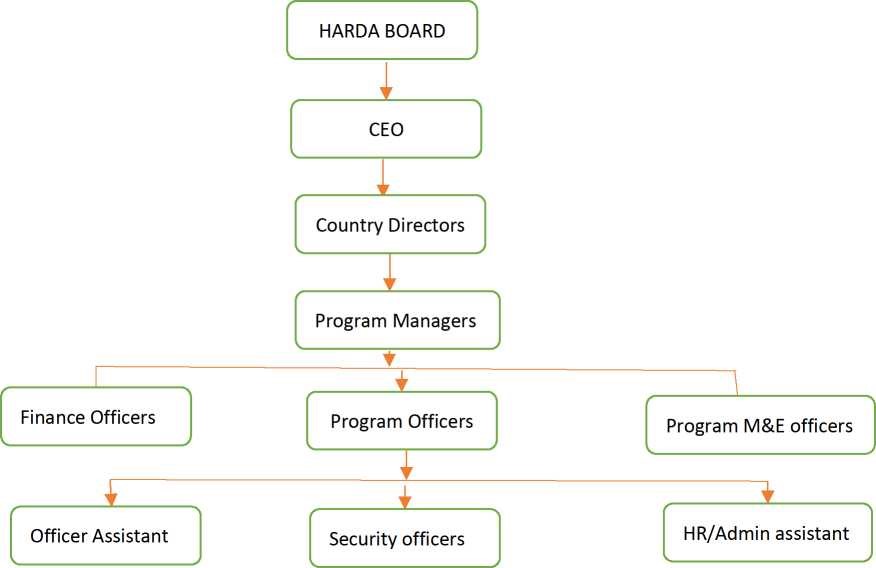
The structure creates space for intellectual creativity and innovation and provides encouragement to staff members and other partners to adopt desirable working conditions. It is also designed to ensure maximum accountability and high-quality output. The key management organs of HARDA comprise of the Board members, CEO, Country director (s), Program manager (s), Program officers, Admin/Finance officers and supportive staff.
For the smooth day to day running of operations as well as effectively and efficiently targeting administration of interventions, HARDA has developed functional management practices, stringent internal control systems and policies to monitor key management aspects and outputs.
The most important systems and policies in place include the Financial Policy, Procurement Policy, Human Resource Development Policy, and Project implementation policy all paramount to successful implementation of programs.
HARDA Organogram